Monday, October 26, 2015

Catastrophic System Failure Part 1 - The Electoral College

...
The numbers don't always add up
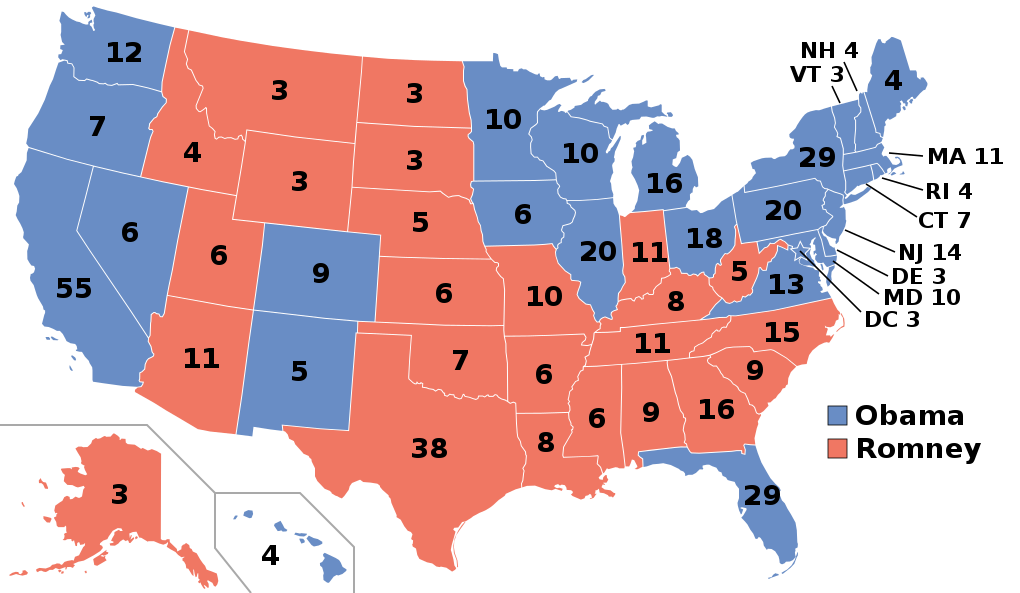
The Republican Party has lost the popular vote in five out of the last six Presidential General Elections in the US. Clinton won in '92 and '96, Gore won in 2000, and Obama won in 2008 and 2012. It's interesting to note that the only General Election they actually won outright was the very first election held after the 9/11/01 terrorist attacks. From this we can conclude that without a major transformative black-swan event, the Republican party is no longer a competitive national party. And this is intuitively reasonable, given that the Republican electorate skews older and whiter than the nation actually is as a whole, and every year that demographic represents a smaller portion of US voters.

So why don't they do something? It's clearly a conscious decision on the part of party strategists to accept the complete loss of the minority and gay vote, and the largest portion of the youth vote. The answer to this question can be found, as can so many other bits of convoluted governance theory in the US, in our national original sin, that Peculiar Institution, slavery. While Wilson and Madison very much preferred a popular election, they recognized that such a proposal stood no chance of success due to the differences in suffrage in the north and the south. At the same time, a system where the President was directly elected by congress ran the risk of an executive beholden to the legislative, diminishing the usefulness of the separation of powers. So they proposed a system where each state would choose a number of electors equal to the number of Senators and Representatives from that state, and those electors would actually cast the votes that elected the executive.

This 'Electoral College' - the term does not appear in the Constitution, but was formalized in federal law in 1845 - is, remarkably, still the system in use today. Now, there are many breathless discussions of how this system could be used to undermine the will of the people - indeed, there is no actual requirement that electors vote for the candidate to whom they are pledged - this is highly unlikely because they are pledged to that candidate for ideological and political reasons. Rather than some kind of inside skulduggery, the Electoral College instead radically changes the demographic realities of a national election. There are about 150 million registered voters in the US, and about 120 million of them can be expected to vote in a Presidential contest. With so many states uncontested 'Red' and 'Blue', a national election isn't dependent on the popular vote, but rather on a few hundred thousand 'swing' votes in highly contested states. And many of these states and regions within them skew to white, christian, rural voters.


You can see the inherent Democratic advantage reflected in the numbers they have locked in already. It's kind of interesting that the vast majority of those 191 starting electoral votes come from just four states - California, New York, Pennsylvania and New Jersey. So you can see quite clearly what this election will be about. The Republicans will be trying to win votes in the Rust Belt, while the Democrats try to exploit changing population dynamics in the Southwest and Southeast. 

But with all the dust and smoke and Ben and Bernie in the Primaries, keep this in mind. The campaign is going to be about a few communities in a few states in odd corners of the country. Your vote almost certainly is meaningless - unless it isn't. This could very well be a close run thing.
...

Sunday, October 11, 2015

On Squeaky Wheels

...
Our Heroes
Year after year, a hundred thousand Americans are shot with guns. Thirty thousand or so die. Another 40,000 - mostly young men - are convicted of a weapons felony and sentenced to an average of 4 years in prison. The families of all these people, their parents and children and spouses and siblings and cousins and friends and lovers - they all find their lives disrupted, their incomes reduced, their security threatened. But what's really interesting about this social, cultural and community catastrophe is that nobody really cared. Oh, there were the usual liberal checkbox for gun control. There were occasional discussions around closing the gun show loophole, or banning certain types of weapons. Small bore, pointless feelgood legislative proposals that nonetheless never went anywhere. Oh well, ho hum, let's talk about taxes.

But along came a tiny population of violent, disaffected lunatics. There was Columbine, and the outrage that followed. Michael Moore made a film, hands were wrung about what we knew or didn't know about what our children were really doing. Then came Virginia Tech, where one crazy kid with two handguns shot 50 people, killing 33 of them (including himself).  Years later there was Sandy Hook. Another crazy man, this time with an AR-15 killed two dozen children and their teachers. And on and on it goes.

Time after time, our attention is grabbed, our outrage is fired, our social media explodes in pain and demands that we DO SOMETHING. Even though mass killings like this represent a tiny percentage of our gun violence crisis, and killings with rifles represents a tiny fraction of that tiny fraction, these are the events we care about. Not, apparently the hundred thousand people who are shot every year, or the million other lives affected or ruined. Just these black swan slaughters.

OK then. If that's who we are, so be it. Given this bizarre condition, we will eventually succeed in regulating firearms in the US, in line with all other developed countries. But only if we have enough of these horrific mass slaughters. Only if a thousand or so people are killed in a concentrated series of these highly unusual murders. We apparently desperately need MORE mass killings, more of them more often. Because it certainly appears to be the only hope we have of saving tens of thousands of American lives every year, and reducing the associated social and economic costs. The only way to reign in the ludicrous availability of deadly handguns in America. The only way to get hundreds of millions of guns out of circulation, increasing scarcity and driving up costs.

It shouldn't be this way. But these heavily armed mass killers of unarmed children, these twisted madmen who leave lakes and rivers of blood in a brief burst of fire and hate, these butchers may be our last, best hope for sanity. In an odd twist that indicates just how insane the gun problem in America has become, if we are ever to succeed in getting our gun crisis under control, these odious, damaged mass killers will be the heroes that made it possible.
...

Sunday, October 4, 2015

P-38 - Mark of Excelence

...
There are at least three things that have carried the moniker "P-38".  And in some cosmic convergence or bizarre coincidence, all three were unprecedented design breakthroughs. Two were seminal enough to remain in use for the better part of a century, while the other had a much briefer production life, but defined a path from the past to the future that influenced similar designs for decades to come.  Whether there is some magic in the 'P-38' designation, or it's all just a tremendous triple-coincidence, you can assume that anything called P-38 is very likely very good at whatever it does.

And in the case of the P-38, the coincidence is even more remarkable because all three iconic P-38s were developed within five years of each other. Here, in approximate chronological order, are the P-38s that changed the world:

The Lockheed P-38 Lightning

The Fork-Tailed Devil
In 1937, Lockheed designed the P-38 Lightening in response to a US Army request for a twin-engine high altitude interceptor. The design team, lead by the design rockstar Kelly Johnson, came up with the famous twin-boom design. The airframe had features that ended up serving it well in both the European and Pacific theaters. The long range and speed of the heavy fighter made it perfect for bomber escort and fighter sweeps over Europe, while the range and reliability of two engines made it ideal for long flights over ocean waters. In both theaters, the heavy firepower of 4 .50 caliber guns an a 20mm Hispano auto-cannon made it deadly in both air-to-air and ground attack roles.

The P-38 was the only American fighter that was in production every day of the war, with more than 1800 still on order that were cancelled when the war ended. The top two American aces of the war, Richard Bong and Tommy McGuire, both flew P-38s in the South Pacific. It was a P-38 piloted by Rex Barber that shot down the Japanese bomber carrying Admiral Isoroku Yamamoto, killing him.

The P-38 served with the US until 1949, rendered obsolete by the jet age. But in its time it was a necessary part of the US arsenal - a heavy, fast, reliable, powerful fighter to complement its  smaller, more nimble brethren.

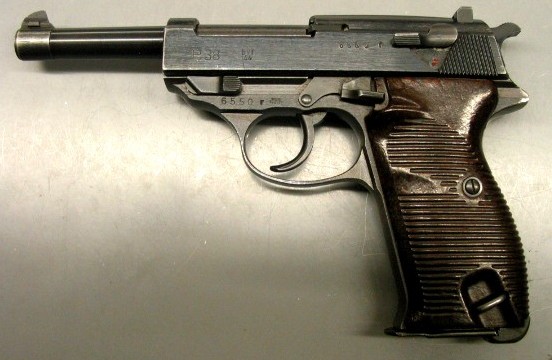
The Walther P-38

A VERY good gun
At about the same time that Kelly Johnson was working on the design for the P-38 Lightening, the German army was considering a problem. They had what was arguably the best military sidearm in the world - the iconic, nearly perfect P.08 Luger. But the Luger was terribly complex, and expensive to produce. With another European war increasingly inevitable, they needed a lot of modern, effective weapons, and that meant cheaper, simpler designs. The Pistole 1938 design was accepted in 1938, and went into full production in 1940.

The P-38 was a true breakthrough in automatic pistol design. It can be fairly regarded as the first 'modern' handgun. The major breakthrough was the DA/SA design that would ultimately become the default for modern autos with the advent of the 'Wondernine' in the early 1980s. This feature allowed the gun to be carried with a round in the chamber and the hammer 'decocked'. A single long-stroke pull of the trigger allowed the gun to be cocked and fired (DA, or Double Action), with subsequent rounds being fired with the hammer automatically cocked by the cycling of the action (SA, or Single Action). The P-38 also included a visual/tactile loaded chamber indicator, a small metal post that would pop up above the surface of the slide when a round was in the chamber. Even in total darkness, you could know for certain whether the gun was ready to fire.

The venerable Walther design is still available today. It has been produced by manufacturers in dozens of countries. I have owned two, a Walther and a Spanish Manhurin version. They are accurate, dependable and easy to shoot well. They are small and light for a service pistol - I often just stuffed mine in the back pocket of my jeans. Some of the early Walthers are collectable, but so many were made, and made so well, that they are still shooters today. Alongside the classic 1911 and K frame revolver designs, the P-38 is an iconic and very long lived 20th century handgun design.

The P-38 Can Opener

You always kept one on the chain with
your dogtags
In the early months of 1942, America found itself at war on both sides of the globe. The 'Arsenal of Democracy' needed lots of almost everything - uniforms, weapons, trucks, planes, explosives  - and food. Food that could be preserved and shipped around the world, in packaging that would stand up to life on the march, and on the battlefield, in all kinds of conditions. In terms of the technology  of the time, that meant sealed in steel cans. And that meant that there had to be a way to ensure that every GI, no matter where he might be, could open those cans. The obvious solution - include a can opener with every meal - seemed impractical at first, but when the C-Ration units were shipped in 1940, they came with an accessory pack that included, along with sugar, gum, cigarettes and toilet paper, an ingenious tiny folding can opener called the P-38. GIs immediately developed the habit of keeping one on the chain with their dogtags where it was readily available.

The mighty little can opener is a classic of industrial design. Simple, foolproof and a perfect solution to a specific problem, the P-38 was ubiquitous in war zones and disaster areas - anywhere there were C-Rations, there were P-38 openers - right up through the Vietnam war. Modern food preservation and packaging techniques have lead to the MRE and the elimination of the steel can, but even today, campers and backpackers happily go into the wilderness with a couple of P-38s in their gear. 

Why is it called P-38? Well, some have said that it's because it measures 38mm in length - which it does - but that seems unlikely as very few Americans had any familiarity with the metric system in 1942. The most common explanation is that, on average, it took 38 twists of the opener to open a standard ration can. 
...

Thursday, October 1, 2015

The Three Little Pigs

...
Amid all the frantic posturing and wild claims emanating from both sides of the gun debate, we find ourselves locked in another endless, circular argument around "assault rifles". What are they good for? Why do we 'need' them? What makes them assault rifles, what makes them desirable, what makes them unacceptable and what would make them acceptable? In all the shouting and flecks of spittle, it's easy to forget that we have been all through this before. Not just the arguments over the original assault weapons ban of the Clinton years - although that event does serve as a kind of a coda to this story - but well before, going back to the years of great firearms innovations from 1960 to 1980.

In this period we saw the rise of a new kind of weapon, a submachine gun the size and form factor of a pistol, characterized by cheap, stamped metal construction, high rates of fire and corresponding large capacity magazines and representing a level of portable, concealable firepower that had simply never been available before. In the end there were dozens of different manufacturers and models, but the family tree has three branches, and at the top of each branch is an icon, a shining star in the firmament of global bloodshed in the latter half of the 20th century.

What was required to kick off this mini arms race was an engineering breakthrough. The challenge is the bolt - it has to have enough mass to operate with the right timing to cycle the weapon. Conventional wisdom had always been that the bolt was behind the barrel, and never the twain shall meet. Slowly, the firearms design community began to think about another option. What if, they wondered, we could extend some of the mass of the bolt over or around the barrel in front of the chamber? You could then envision a system that would use a ten inch barrel and would only be fourteen inches overall. Then, if you put the grip under the chamber and loaded the magazine in the grip, as in a typical automatic pistol, you might just be able to build something that had never been seen before.

In the beginning, there was Uzi

Where the HELL did he get that thing?
The revolution started small - or rather large. In the early fifties, designer Uziel Gal was working on a 9mm submachine gun for the Israeli Defense Forces. His design utilized the breakthrough telescoping bolt, extending it forward past the breech to provide it with enough mass to make the gun cycle reliably. The magazine fed through the pistol grip, and while the early versions had long barrels and fixed stocks in 1954, it evolved into the tiny, deadly weapon we saw most famously appear from nowhere during the attempt on President Reagan's life in 1981.

The world noticed, an icon was born, and weapons design would never be the same. The concept was irresistible - a small, concealable, high capacity automatic weapon was a game changer. Its time had come.

Shortly after the success of the Uzi came the MAC 10

Miami Vice had their finger on the pulse of
American firearms in the '80s. And white
Linen jackets.
In the mid-sixties, Gordon Ingram took the idea of the Uzi, stripped out all of the quality and elegance, and made a small, ugly, ridiculous gun that became the weapon of choice in the drug wars. The MAC 10 was a crude, stamped, welded .45ACP submachine gun that was eleven inches long and weighed six pounds.  It was clunky and ugly and worst of all, it had a ridiculously high rate of fire - for technical reasons around the distance the bolt had to travel, it was very hard to reduce without affecting reliability. So it fired 1000 rounds per minute in .45 ACP - the equivalent of a full 30 round magazine in a little over a second. Not terribly useful in an extended firefight.

The MAC 10 spawned lots of imitators, primarily because the companies that made it kept going out of business. But it became ubiquitous in the '80s - I had one of the Cobrays in 9mm that my fiance bought for my birthday. As crude and cheap as they were, they were so simple that they were utterly dependable, and you could push 30 rounds downrange in the blink of an eye. With the very short barrel, loose tolerances and the tendency to load cheap 9mm realoads - if you are loading a bunch of 30 round magazines, cost starts to become a consideration - accuracy was not great. Although it was hard to hold and aim, so it was an ongoing debate as to the inherent accuracy of the gun - but it was designed to put a LOT of lead downrange, and it did that very well.

But now we were getting into the late '80s, street violence was off the charts, crack wars were raging in Florida and gangs were exploding along with the growth of crack cocaine. And that leads us to the final straw.

As street crime and the drug wars heated up in the '70s and '80s, the US market responded with the TEC9

He seems to have anger issues
As the cocaine and gang wars of the 80s continued to dominate both the news and popular culture, a company called Intratec - a spinoff of a Swedish arms manufacturer - produced a design destined for infamy, called the TEC-9. The TEC-9 was a little different from its fellows - it was designed from the ground up as a semi-auto for the American market, and despite its own version of the telescoping bolt, it had a magazine that loaded in front of the pistol grip. Rather than being a submachine gun re-designed for civilian use, it was a high capacity semi-auto pistol targeted on the civilian market from the very beginning. And since the earliest versions fired from the open bolt, converting it to full auto was trivial. Eventually, Intratec was forced by US regulators to redesign the TEC-9 so it was much more difficult to convert, but by then there were dozens of copycats and knockoffs. If any one weapons design drove the first round of 'assault weapon' bans in the '90s, it was the cheap, deadly little TEC-9.

Now, there is a reason why, out of 12,253 murders in the US in 2013, only 285 were committed with rifles. They are big, expensive and impossible to carry or conceal. So it is these very small, high capacity weapons that use the ammunition and form factor of the handgun and build onto it the firepower of an assault rifle that are probably a more realistic concern. But of course, the real danger is the availability of the plain vanilla, run-of-the-mill handgun, any old thing you can stuff in your pocket or in your belt and reach for when you're angry, frightened or drunk.

But trying to legislate against certain kinds of rifles due to a few very bloody, high-profile incidents is not productive. Whether you want it to be true or not, rifles like the AK-47 and AR-15 do have many legitimate uses - the argument "why would you NEED one of those?" simply doesn't hold water. But guns like the three little pigs? These are street guns, concealable killing machines, and while they are ridiculously fun to shoot (full disclosure: I had a MAC-11 for a number of years in the '80s), they really don't have much purpose beyond putting a lot of lead downrange in a very short period of time from concealment.
...

Wednesday, September 30, 2015

Make America Great Again

...
You can tell he's stupid because his lips are moving
This is, as you surely are aware, Donald Trump's campaign slogan. It always strikes me in a number of ways as being kind of tone deaf and off-putting. First of all, why aren't all the other Republican 'American Exceptionalism' candidates shrieking that America is the greatest country in the universe, and Donald is saying we're NOT great? I suspect because even they don't want to claim an America lead by that noted Marxist/Kenyan/Nazi Barack Hussein Obama could possibly be great, even if it America, which is always great. Or something.

But what is that Trump is saying? What would make America great again? Why, it's about growth, and business, and trade, and making good deals, and creating jobs, and building infrastructure - Walls, lots and lots of WALLS - and deportations, and military power, and threatening adversaries, and threatening allies, and all the other things you'd expect when you combine entitlement, bluster and ignorance.

Now, ask yourself: What do all these things have in common? Money. They all cost money. Trump is essentially talking about undertaking a series of large-scale investments, to the tune of several trillion dollars over two terms. Plus, he's now proposing very large deficit financed tax cuts. Of course, he just waves that off - he's too SMART to have investments cost money - but we know that's just because he's a.) too lazy to actually do any research and b.) dishonest enough to be willing to promise everyone a free pony.  This at the same time he's claiming to be a great businessman, and he can't even speak to the value of good investments because of the Republican government spending obsession.

But there's the key trade-off in modern American politics. What will government do, and what will legislators fund? We're making a series of desperately poor decisions now, around how to fund the Highways and choosing NOT to fund infrastructure and R&D/Big Science projects. The refusal of the institutional Republican party to allocate any resources while everything just gets older and we fall farther behind is the most frustrating thing to watch I can imagine.

So here comes The Donald, saying no, no, we CAN do all these things, we just don't need to actually PAY for them. Donald Trump will not be the President of the United States, but people would do well to think about what he's saying - not the self-aggrandizing nonsense, but the part about how we need to invest in our own future, and we need to start NOW.
...

Tuesday, September 29, 2015

Today in Pointless Destabilization

...
Let's start with this - nuclear weapons policy is desperately important. We're fooling around on the edge of extinction, and we need to be very certain we understand what we're doing and how it's being interpreted around the world. And the current bloodthirsty arrogance of the American and Russian leadership - coupled with the beligerent assertiveness of the increasingly capable Chinese military is frightening in this context.

During the cold war, the US and Russia, along with minor contributions from Europe and China, learned to use their nuclear arsenals to prevent nuclear war. It was a thing nobody wanted - if you can't win, what's the point in even playing? So elaborate signaling and systems grew up, even as systems evolved to the incredibly dangerous "Launch on Warning" standard we still carry today. But even so, when something went pear-shaped - and it did fairly often - they were able to avoid the most obvious, and horrific, outcome.

 The problem is, as technology advanced, the window for decision making got shorter, and we're now faced with a condition where it would be very easy for the situation to outpace our ability to manage it. And yet, the cold-war logic holds even today, if we operate within its constraints. Here's what you can't do - you can't build a system that takes you out of the 'MAD' - Mutually Assured Destruction - construct. As long as we sink or swim together, we can work together to prevent the use of strategic nuclear weapons. The situation is destabilized, however, when one side or the other has a qualitative advantage that would permit it to launch an effective preemptive strike that effectively 'wins' a nuclear exchange by preventing substantial retaliatory strikes by the targeted country.

There are exactly two ways you can do this - using anti-missile technology to render your nation invulnerable to ICBMs or to develop a weapon/delivery platform combination that would allow you to eliminate your opponents strategic capacity without warning. This combination of stealth, accuracy and weapon effectiveness is much more likely to find itself in play than some kind of imaginary missile defense system.

Which brings us to the US Nuclear Weapons Policy. The Obama administration has affirmed that they will not develop 'new' weapons, but just where the line between updates and modifications to existing designs and entirely new weapons is can be difficult to agree on. A nuclear weapon is comprised of the nuclear explosive element itself, called the 'physics package', the mechanisms that render it safe until they actually detonate it, and the 'packaging', the functional bomb or missile itself. If you retain the same physics package, but you add modern digital control circuitry and an advanced guidance and delivery package, is that a new weapon, or just an upgrade to an existing weapon?

That is the effective description of the B61-12. The US has had the B61 thermonuclear gravity bomb in inventory for decades. It's always had a few key features - variable yield technology, and limited accuracy. The B61-11, fielded in 1997, was built in a ground penetrator 'bunker buster' configuration. The B61-12 is the same 'physics package', but packaged in a modern precision-guided gravity bomb and deliverable from stealth aircraft like the B-2 and the F-35. This combination of stealth, precision and low yield make it ideal for decapitation and anti-nuclear first strikes, which makes it inherently destabilizing. When the Russians have to realize that the first they would know about a US first strike would be the destruction of the Kremlin or their missile silos, their finger is going to be that much tighter on their own nuclear trigger.

So we have to ask: Why? Why do US forces see a need to turn a 1970s era gravity bomb into the most destabilizing nuclear weapons system in the world? What problem are they solving with the B61-12? The answer is as obvious as it is frightening. They are working not to preserve a strategic 'balance of terror', but rather their own budgets. They have to walk a fine line, being able to plausibly claim these are mere upgrades of existing weapons, but the only way they can deliver an upgrade is to turn a city-killer into a silo-killer. And make no mistake, the Russians and Chinese are watching very closely.
...

Sunday, September 20, 2015

Slouching Toward Armageddon

...
End Game for al-Assad - for the rest of them
there will be no end to the killing
The issue is no longer in doubt. Syria is falling. The al-Assad regime no longer has the personnel and military organizations to effectively fight the various forces in action in the North around Aleppo. There are currently ISIS, al Nusra, Kudish forces and the loose aggregation of insurgents often referred to as the 'Free Syrian Army', or simply as 'Syrian Rebels' in combat with each other and the Syrian Armed Forces, but after nearly five years of non-stop warfare, the Syrian loyalist troops are depleted, exhausted and frightened. One of the advantages the Islamist groups have is al-Assad's forces bowel-loosening fear of getting captured by them. The loyalist troops will abandon their positions long before the fight is over, just to make sure they make it back to the next secure town or village before they get overrun.

Bashir al-Assad and the mostly Alawite Ba'ath leadership has had ongoing support from Russia and Iran. The reasons for this support are complex, but the simple explanation is that Russia needs Syria because it provides them with a proxy state in the Middle East and Iran is supporting the government because, as Alawites, they are Shi'ite Muslims, and the opposition is almost entirely Sunni.

So with the government forces on the run, losing territory to ISIS in the East and Syrian Rebel forces and al-Nusra in the West, it is not surprising that both Russia and Iran would step up their support. Russia is particularly concerned about the rebels westward advance. Idlib fell in March, and Jisr al-Shughur in April, and now the rebels are only ten kilometers from the Mediterranean seacoast, and only 20 kilometers from Syria's primary port, Latakia. Even worse for the Russians, their only naval base on the Med is at Tartus, just another 84 kilometers down the coast road. Meanwhile, Iran needs a friendly Syrian government to retain access to Hezbollah in Lebanon and Hamas in Gaza.

So Russia has undertaken a buildup of their own frontline equipment, including tanks, APCs, attack helicopters and modern multi-role fighter jets. There's even some evidence that they've brought in advanced air defense systems, the significance of which we'll get to in a minute. It seems pretty obvious that this is a precursor to the deployment of Russian combat troops in Syria in support of Bashar al-Assad and his core leadership group. The justification will be they are fighting ISIS and the other Islamist militants - hmm, that sounds awfully familiar - but make no mistake: They are there because the Syrian army no longer has the combat power to hold on to their remaining territory.

So this will bring Russians, Syrians, Kurds, ISIS/Nusra, Hezbollah, Gulf States and American militaries into close proximity in a combat zone. And why do the Russians need anti-air defenses? ISIS doesn't have any air assets, and neither do the Kurds. The only combat air assets in theater will be Syrian, Russian and American/Allied - and occasionally Israeli. The likelihood of a fatal accident or mis-calculation is very high.

When the Syrian revolution started, the world thought it was just another Arab Spring uprising against an authoritarian dictatorship. What we forgot to notice is how strategic Syria was to a large number of powerful external entities. And no matter what happens - if the Ba'ath leadership can hold on to power and some territory or not, if al - Assad clings to power or steps aside, if the Damascus perimeter holds or if the capital city falls  - Syria will remain a war torn failed state for many years to come. The refugees will continue to stream out of the area, the the Iraqi and Syrian borders will be erased and the region will continue its spiral into chaos and desperation. Only now we also have an opportunity for it to explode into a major powers confrontation and an unpredictable and dangerous regional war.
...