Saturday, June 8, 2013

All Hat and No Fighter Jets

...
He looks totally serious to me
The people of Pakistan are angry.  They're fed up with their nation being regularly bombed by their supposed 'ally' the United States.  The Pakistani judiciary has ruled that attacks violate Pakistani sovereignty, and the political class regularly condemns, decries and denounces the attacks.  Yet they continue, a drumbeat of foreign military action leaving death, destruction, tragedy and anger in their wake.

In the recent elections, the American air attacks on Pakistan were a major issue.  All the candidates wanted the people to believe they would do something about the drones. The PPP had no credibility in this area - they had tacitly agreed to American air attacks against Pakistani villages in the north for years.  On the other side, Imram Khan's PTI was the full-throated voice of the Pakistani people in raging opposition to the attacks.  The eventual victor, Nawaz Sharif, has expressed firm opposition to the drone attacks, but it is far from certain how, or if, that will manifest itself now that he is Prime Minister.

It's a fairly straightforward question.  The US is not at war with Pakistan, and bombing another nation is generally considered an act of war.  Repeatedly bombing another nation is certainly indicative of a state of war.  Pakistan has a well equipped, modern air force and air defense system as a result of its longstanding fear of war with India.  The drones in use cannot operate in contested airspace.  They are not stealthy, they carry no air-to-air defensive capability and they operate at very low speeds and altitude.  They are vulnerable to ground fire and fighters, but it would probably be most effective to go after them with attack helicopters.

The fact that Pakistan does not defend its airspace from these incursions by officially unidentified aircraft is all the proof one needs that they are complicit in the attacks.  That makes the endless condemnations of their government and military a farce, and leaves the whole situation messy and unstable. It will be very interesting to see what PM Sharif does at this point.  If there is an agreement with the US, he was certainly not a party to it and would not be bound by it. He could officially terminate it and tell the US Military Liaison that they will, henceforth, shoot down unknown aircraft in their airspace.  The US could not retaliate directly for the 'offense' of air defense - every nation has that right.  It's also interesting that President Obama's speech announcing significant changes to US drone policy came as Sharif was elected - they may have a deal with him already, but for a much more limited program.  Still, there have been two attacks since his election - that doesn't seem terribly 'limited' - so it continues to be an open question if Pakistan will end the bombing.

No matter what happens this month, the status quo doesn't seem sustainable. Pakistan's government cannot go on pretending to oppose an American air war they refuse to defend their own nation against, particularly in the face of increasing public anger.  It's a fair assumption that there is a quid pro quo involved, and that the US would find ways to make Pakistan suffer if they put an end to the killing, but it can sometimes be surprising where political courage can be found.  I'll be the first to admit that an authoritarian steel magnate with a sketchy political history would be a very surprising nationalist hero, but time will tell.
...

Saturday, June 1, 2013

Politics - The Object of the Game

...
Let's review.  People hold beliefs, formed in a variety of ways, about how their communities and society should be governed, and the appropriate and effective application of public policy.  People with similar beliefs come together to form political organizations, and ultimately political parties, to attempt to advance these ideological and philosophical beliefs.  The methodology of advancement is politics.  Politics is really nothing but a popularity contest - with democracies all structured around the organizing principle of "majority rule", the goal of the political movement is to gain the support of the majority for your party's ideology and the underlying policy agenda.

Simple enough, but often lost in the shouting over specific issues.  Thus it's sometimes worthwhile to step back and review first principles.  A successful political organization is one that achieves the political power to implement its favored policies.  This is entirely separate from what those policies might be in specific - success at the political level means nothing more or less than gaining and retaining a majority so as to be the party in power.

Which brings us to the hothouse of hatred and exclusion that is today's Republican party.  It all started decades ago with the realization that they could advance their political popularity by supporting a set of social positions as part and parcel of their ideological agenda.  This served them well for a very long time, leading to the pinnacle of political success for movement conservatism with the 2004 "God, Gays and Guns" Presidential election.  The problem with including purely social issues in a public policy agenda is that the broad view of those issues can change, sometimes suddenly, sometimes generationally, but in any instance these are views that need to evolve more than policy positions on more traditional economic and governance matters.  That is, they need to evolve in order to achieve political success, which has previously been the primary goal of a political organization.  This no longer seems to be the case, however, with the GOP.

Increasingly there seem to be a series of Republican political and media leaders who have completely lost sight of the connection between ideology and politics.  Instead of working to sell their public policy ideas in order to attract as many supporters as possible, they seem to instead wield their divisive social and ideological positions as a club, without either the recognition or even concern that they are doing tremendous damage to their political goals.

It was bad enough when they lost the African American, Gay and secular votes.  They could at least build a narrative that they were sacrificing the votes of small, specific groups that were unlikely to support their policy agenda in order to appeal to the broad center.  At some point, certainly, if your political movement succeeds in alienating enough 'small groups', what you end up with is a broad opposition coalition that can prevent you from achieving a majority - and that's where the Republicans already find themselves.  But now the attacks on women are just inexplicable.  This has nothing to do with policy - their policies, from reproductive rights to equal pay to paid leave have always been strongly anti-women, but the other social positions tended to position them to keep from losing women's votes by large percentages.

But now, from Todd Aiken to Erick Erickson, the voices of movement conservatism are being raised in expression of support for an institutional inequality that is clearly recognized as heinous misogyny by all who have experienced it firsthand.  It was one thing politically to represent the party of white supremacy when whites represented well over half the voting population, but women ARE half the voting population.  And the amazing thing to an outside observer is just how unnecessary these self-inflicted wounds actually are.  The general cultural dominance of men over women could be supported, if not completely preserved, by the old standard policy positions of pro-life, pro-church and pro-family stalking horses that allowed them to preserve a strong women's vote while essentially holding these same male-dominant beliefs.  A full-throated cry for what can only be accurately described as discrimination against women is unnecessary from an ideological standpoint and clearly counter-productive politically.

Part of me wants to just shrug my shoulders, make some popcorn and watch the train wreck.  The Republican party has become so foul, so fascist and un-democratic, so destructive to lives and communities, that its ultimate demise as a national political power cannot be seen as a bad thing.  But it's also worrisome, in that if the result is a dominant Democratic party and a fragmented, splintered, ineffective opposition, the result is single party rule and the risk of a drift into even greater authoritarianism and autocratic governance.  If history has taught us anything, it is that those with unchecked power will always seek even more unchecked power, and the outcome is never good for the people in the community.
...

Tuesday, May 28, 2013

A Stopped Clock, Or Something A Little More Important?

...
Yeah.  ALL the amendments are important.
One of the great frustrations with the Tea Party is that they often have a chance to demand important constitutional protections in a manner that would provide wide bi-partisan support, and yet every time they seem to choose hypocrisy over consistency. They love an originalist interpretation of the Constitution, but somehow their demands for an unequivocal defense of the second amendment is often not mirrored by an equivalent defense of the first, fourth or fifth.  And their full-throated defense of individual rights in the face of government intrusion never seems to extend to reproductive rights, religious freedom or sexual and gender equality.

And yet their stated ideological positions, writ large, offer a great opportunity for a liberal/conservative coalition on issues of personal freedom, individual liberty and constitutional protections.  If they would only hold true to their stated beliefs, even when to do so put them in agreement with a liberal agenda, we would have a chance to hold back the ongoing selective limitations on rights guaranteed by the constitution.  And guess what?  Finally, as the issues of freedom and community come into stark relief, it's tremendously reassuring to see the the wingnuts demand that the government live by the laws of the land.  And even more importantly, we see a far-right political leader putting her citizens first, not just accepting but fighting for federal health care resources in the face of ideological intransigence.

So what are we to make of this?  The Texas state legislature, perhaps the most reactionary right wing body in the US, passed HB2268, without doubt the strongest email privacy legislation in the nation.  The bill would provide Texans with a powerful set of privacy rights at the state level, although, of course, federal law enforcement in this area is still governed by the tremendously flawed 1986 ECPA.  Of course, Texas governor Perry is loathe to support anything that liberals approve of, but given that the bill passed both Houses without a single "nay" vote, he might feel somewhat constrained to simply veto it.  His alternative is to do nothing, in which case the Bill would become law in mid-June and take effect in September.

However, that development pales in the face of the battle of Arizona.  It turns out you can say just about anything you like about Arizona Governor Jan Brewer - right wing, inflexible, reactionary, politically inept, racist - and you might be right in every case.  But who knew she also took her role as Governor seriously, placing the well being of constituents above her political ideology?  That's the kind of thing politicians claim, but you just never see them stand firmly behind it regardless of cost.

In January Gov. Brewer announced she would be supporting the Medicaid expansion in the ACA, often referred to as "Obamacare".  This is a no-brainer for any rational Governor, because it uses federal funds almost exclusively to expand the ranks of people covered by Medicaid. It allows many otherwise uninsured citizens to receive subsidized health care at minimal cost to the state coffers.  Republicans hate it, and have taken a stand that they will allow their poor citizens to suffer and die in significant numbers rather than take the federal funds.  But not Governor Brewer. In a surprise announcement, she said her administration would participate in the Medicaid expansion.  Her legislature was less than sanguine, and have done nothing to implement that goal.  That left the Governor with two choices - back down and let ideology take its course, or go to war with her ideologically simpatico legislature.  Bet you didn't see this coming.

She told the Legislature they were out of the lawmaking business until they implemented the Medicaid expansion.  She announced her intention to veto EVERY bill passed until then.  The congress was unconvinced and sent five bills to her desk this week.  She vetoed every one.

It. Is. On.

The Arizona Senate has agreed to the Medicaid expansion, and the battle between the Statehouse and the House of Representatives grows increasingly tense.  Nobody wants to back down, and it's hard to know who holds the strongest hand.  But the interesting thing here is that common sense and statesmanship is being placed above ideology.  By Jan Brewer.  To the point where she's willing to buck her own allies.

I don't think this is some kind of a trend, necessarily, but it could very well be the beginning of some kind of minimal self-awareness from some members of the political right.  There should be some recognition that your first job is to govern effectively, and it's only secondarily that you can use your position to promote an ideological agenda.  And maybe we're seeing some of that...
...

Saturday, May 11, 2013

It Works!! Now What?

...
Cody Wilson risks life and limb to
prove a concept
On May 2nd, Forbes staff writer Andy Greenburg and a photographer accompanied Cody Wilson to a remote Texas firing range with a breakthrough in firearms technology.  Well, the technology is evolutionary, the breakthrough is more conceptual.

The gun in question is called "The Liberator", after the disposable single shot .45s dropped across occupied Europe in the second world war.  The idea was you used this simple, cheap gun to kill a soldier and acquire his more effective weapons.  Except that while the modern version is a single shot .380 of vaguely similar design, it has the distinction of being downloadable.  That's right - the entire gun (except for the use of a common nail for a firing pin) is ABS plastic, built over a period of hours on an increasingly commonplace 3D printer.

Now you might question Wilson's ideology, or even his sanity, but you may rest assured he is not stupid.  The first tests of the new all-3D printed handgun were conducted at the end of a 20 foot string tied to the trigger.  With the exception of a mis-fire due to a mis-aligned firing pin, the tests went well.  The next day, accompanied by his father and Greenburg, amid nervous discussion of the location of the nearest hospital and the availability of materials for a field-expedient tourniquet, Cody Wilson loaded and fired the gun himself.  Again, it worked flawlessly.

As alluded to above, this is not really a conversation about technology.  This technology was inevitable, and is still in its infancy.  Designs will improve, the 3D printers will become more broadly available, and most importantly, the materials will become more robust.  Much more importantly is what it means about freedom, democracy, speech, and their limits in a technologically advanced society.  The key problem is the gun's existence in the actual physical realm is fleeting, measured in hours or days.  Before that it is merely information, a collection of bits on a server somewhere in the world.  In very real terms, it is a lethal weapon that can be 'conjured' when needed, and then eliminated immediately after use.

The first shrieks of panicked outrage you'll hear are that it finally fulfills the original myth of the Glock - a plastic gun that can be carried through metal detectors without risk.  Because Wilson's company, Defense Distributed, is a licensed Firearms manufacturer, in order to comply with existing laws about the detectability of handguns, there is a slot inside the frame that holds a six-ounce steel plate.  But there would, of course, be no way to require or enforce the requirement that downloaders actually include the steel plate in the assembled piece.  In fact, however, this is a red herring.  Setting aside the fact that the ammunition will be detectable, the very idea of hijacking an airliner has become something of a non-issue after 9/11.  Nobody will sit by and allow a hijacker to take control of an aircraft - the calculation is not that some might die, but a generalized refusal to allow all to die.  Along with air marshals and hardened cockpits, airlines are protecting against destructive devices, not plastic guns.

No, the real issues are bigger, and harder than metal detectors.  The issue is the ability to acquire a gun on demand, without a transaction - indeed, without any intermediary whatsoever.  There is no point in that process where the history, stability and intentions of the individual can be considered or investigated.  The interesting challenge is that the gun becomes an abstraction, existing only in the cloud until, with a few clicks, it can be made real and functional by anyone with an Internet connection.  What that means, and how it will affect our society is entirely unknown.  But along with drones, ubiquitous surveillance and the end of privacy, it signals a post technological society far different from the one we hoped for...
...

Saturday, May 4, 2013

Classical Gas - Hot Air or a Lot of Nerve?

...
Oh Look!  Here's some now...
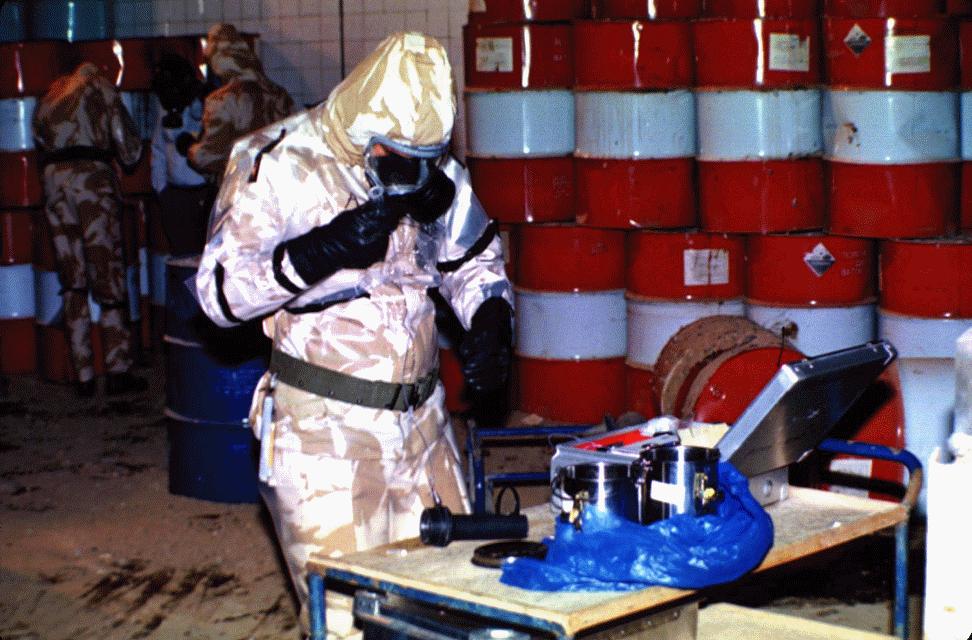
It is a given that that the Syrian military under the command of Bashar al-Assad's Baath party has substantial stockpiles of chemical weapons.  It is widely believed that they have the ability to deploy both blister agents such as Mustard Gas as well as nerve agents like Sarin.  Now, regardless of how many times they say it on TV, these are not the dreaded "WMDs".

It has become a common, if unfortunate convention to identify chemical weapons as Weapons of Mass Destruction, alongside nuclear and biological weapons, but this is clearly wrong.  It is part of an overall modern tendency of "threat inflation" that governments use to elevate any situation they choose to a state of existential conflict, a condition under which they can take actions that otherwise their populations would find unacceptable.  But chemical weapons are battlefield weapons, not capable of the destruction of a large modern city or an entire population.

Which isn't to say that chemical weapons aren't horrible in their own way.  They kill in truly awful ways, if there is some kind of scale where being blown into pieces by an airstrike or left to bleed out with large caliber bullet wounds occupy one level and suffocating under the effects of toxic gasses that operate much like pesticides on a human scale might somehow be judged more awful.  But even more to the point, they kill indiscriminately without control or guidance outside of the prevailing winds. This makes them a nearly ideal weapon of terror, if not actually of mass destruction.

The existence of these chemical stockpiles in Syria creates a number of genuine concerns.  The first is that al-Assad might order their use against the rebels - even though they are operating in dense urban environments with large civilian populations.  Then there is the equal and opposite concern that the rebels will overrun a military base with a chemical weapons inventory and use them against regime forces, which are also in that same kind of densely populated environment.  But a much greater concern - at least to people outside of Syria itself - is that any number of players, from the Syrian army to the rebel forces to organized criminal factions might gain possession of these weapons and transfer them to other groups or organizations.  Some of the Syrian rebels are jihadis, with ties to the original al-Quaeda, and the Ba'ath government is supported outright by Hezbollah in Lebanon.  Other non-governmental groups throughout the region would happily buy a few containers of Sarin gas for their own purposes.  And famously, the Obama administration has declared the use of chemical weapons to be a "red line" that would necessitate an American military response.

The frightening part of all this discussion around Syrian chemical weapons is summed up neatly in the principle of Chekhov's Gun.  As Anton Chekhov famously wrote in 1889, "One must not put a loaded rifle on the stage if no one is thinking of firing it."  With all this rhetoric around these weapons, the almost magical qualities attributed to them and the power they have been granted to change the very terms of the civil war, it seems unlikely that they won't ultimately become a key part of the conflict.  al-Assad has nothing to lose - he'll never leave Syria alive at this point, and even if he does, they can only hang him for war crimes once.  The rebels are virtually praying for a large scale unambiguous deployment of chemical weapons, an act that might bring real external military power to bear on the remains of the Ba'ath - Alawite regime and quickly bring an end to their power.  Palestinian groups, long killed and imprisoned by Israel with impunity see the possession of sufficiently terrible weapons as a way to level the playing field and give them some leverage in negotiations.  With all of these pressures from so many different directions compelling their use, it seems inevitable at this point that they will become the focal point, and perhaps the end-game, of the Syrian civil war.
...

Thursday, May 2, 2013

How Do You Solve a Problem Like Korea?

...
Hey! How'd he get such a hot babe?
What to do about North Korea?  Everybody agrees that the best solution is diplomacy, negotiations to resolve the conflicts that are creating tensions on the Korean peninsula   But if you think about it, is there really anything to negotiate?  Put another way, what would a "deal" with Kim Jong-Un look like?

Unlike most other nations, North Korea has nothing of value to offer the world.  They are an impoverished, backward nation without enough agricultural, manufacturing or hard currency output to meet even their own most basic needs.  Really, the only demand the West can make on them is to stop being such a dick.  But being a major dick is their only export product, and the only quid pro quo they would see as being worth accepting would have to be nearly both infinite and eternal.

Like a spoiled child seeking attention by demanding concessions in exchange for (temporary) good behavior, the best approach would seem to be to simply ignore the tantrums.  The assumption would be that Kim doesn't really want war, and China most certainly doesn't want to see his government collapse and the Peninsula re-unified under the auspices of Seoul and the US.  The risk would be that the Generals would continue to escalate to try to regain the initiative in "negotiations" to the point where something very bad happened almost of its own accord.

But if we are to be honest, we have to recognize that this strategy isn't simply being driven by the North Koreans.  Western governments, particularly the US military and political leadership, long ago fell into the habit of threat inflation.  They discovered that they could get everything from budget increases to anti-democratic legislation to outright aggressive war by creating the image of catastrophic or existential threat.  This culminated, of course, with the ridiculous vague conflation of various weapons programs as "Weapons of Mass Destruction" in Iraq, creating the utterly artificial construct that the Iraqis, economically and militarily crippled though they were, represented an actual threat to the United States of America.  It is impossible to effectively describe the magnitude of this delusion, but there can be no doubt that it was created for political purposes and it proved politically effective.

So now we have another impoverished third world nation making outrageous claims as to their military capacity, and once again our Generals and Legislators and Pundits respond predictably, accepting the claims at face value or even giving them additional gravitas all on their own.  While it seems obvious that the best diplomatic and military approach to North Korea would be to ignore their irrational ranting - they don't want war, and won't start one on their own - our very own government and media leaders grab onto Kim's threats because they see them as an opportunity to increase their own funding, prestige or leverage.
...

Friday, April 26, 2013

On The Unusual Historical Significance of a Certain Vice President

...
Still giving the orders
Vice Presidents don't matter much.  In terms of policy, they tend to have less influence than the First Lady, and while some have had more importance than others, overall they don't tend to leave their mark on history.  But it may well be that there was one whose influence, choices, ideology and policy agenda will echo through American and global history for the next hundred years, if not more.  That VP is none other than Dick Cheney.

With the opening of the George W Bush library this week, there has been some re-examination of the Bush Presidency, which feels weird because there's been a pretty robust consensus that nobody would ever talk about him again,  and he would be allowed to slink off into history the way the horror of a bad dream fades as the morning progresses.  Even the odious former President has limited his public appearances, preferring instead to publish a book and learn to paint.

But in the course of revisiting the Bush White House, it becomes apparent that, in spite of the ultimate unmitigated disaster that was the Bush Presidency, there were a surprising number of issues, from AIDS to education to homelessness, even to health care where the Bush policies were well-meaning, compassionate and, most remarkably, effective.  Now make no mistake - at the end of the day, GW Bush was an incurious, bumbling nitwit, utterly unqualified to be President of the United States,  completely controlled and manipulated by government and party staff.  And much of his National Security, Intelligence and Foreign policy was dictated by the Vice President's office, Cheney and his band of bloodthirsty armchair warriors.

Which leads me to wonder: Just how much of the horrors, madness and monumental failures of courage and vision of those years would have been avoided merely by the selection of a different running mate in 2000?  How different might those years have been, and how many debacles - from torture to warrantless surveillance to indefinite detention to the invasion of Iraq - would never have happened at all, and what events and accomplishments might have stood in their place?

So often in the Bush era the actions of his Administration would engender the question "stupid or evil?"  And sure enough, in the case of a presidency that resulted in such widespread disaster, there's room for both.  But I can't help but believe that Bush mostly supplied the stupid, while the evil was largely contributed by Dick Cheney.  It's hard to even fathom the depths of anger and inhumanity that the originally bookish politician Cheney turned to after 9/11.  His lust for murder, torture and an odd, uncaring deployment of massive military force without any serious consideration of strategy, without any interest in post-combat planning, political or diplomatic management or any real advancement of American goals and interests is even more chilling in retrospect than it was at the time.  He seemed only interested in inflicting maximum pain and suffering, destroying and killing without any thought to what would be accomplished.  The most favorable interpretation of his random bloody-mindedness-as-policy is that he hoped to intimidate the world into kowtowing to some kind of Pax Americana.  The less charitable, but more realistic assumption is that, at some point, he became a rapacious homicidal maniac in control of the most powerful military on the planet.

The costs were immense, and are still being counted.  And not just the costs in blood and treasure.  America used to hold a kind of moral high-ground, a place from which we could at least challenge those who would use undemocratic and extra-constitutional practices like torture, detention without due process and unlimited government surveillance in the court of world opinion.  Now, of course, any brutal dictator, from Putin to Assad can invoke the generalized concept of "terrorism" to justify any act, no matter how horrific, and, if challenged, can point to that icon of human rights, the United States, as the model for their behavior.

So as we watch the attempt to rehabilitate the legacy of President GW Bush, two things should be uppermost in our minds.  First, he was a disaster of the first order as President, an incurious and bull-headed ideologue uninterested in any knowledge beyond his own preconceptions, but he was ultimately probably not as bad as the actual legacy he leaves behind.  A great deal of the real horror of the Bush years stains the hands of his Vice President.
...